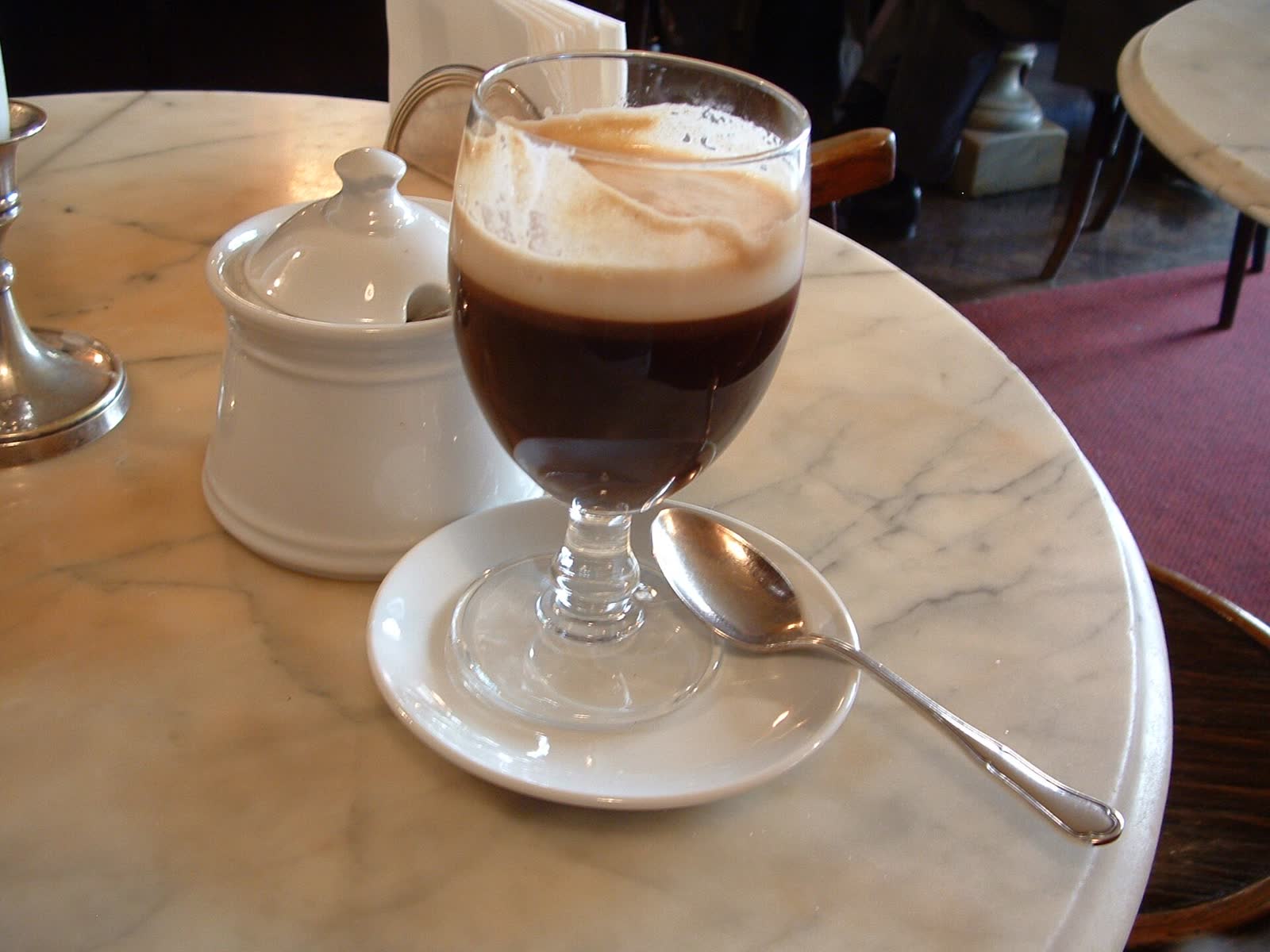
In Turin, coffee isn't just drunk: it's a ritual. And the most Turinese ritual of all fits in a small glass with no handle.
I live in Turin, so this notebook is a home game. The bicerin (say bee-cheh-REEN; in Piedmontese it simply means "little glass") is an espresso, a very thick hot chocolate and a layer of milk cream on top. Three things you probably have at home, served in a way you won't find anywhere else: in layers that don't mix, so every sip goes through all three.
It was born in a tiny café facing the Consolata Sanctuary, opened in 1763, which still has eight little marble tables and a queue at the door at weekends. Since 2001 the Piedmont Region has listed it as a traditional regional food product.
Below you'll find exactly what it is, where it comes from, how to order it without looking like a tourist, what it costs in 2026, the original's opening hours and a walking route of about four kilometres through the historic cafés of the centre, with a map.
From the Consolata to Platti, on foot
Tap any café to see its photo, year and address, or press Walk the route and follow the walk through the centre. The line is a real pedestrian route along streets and arcades.
Three layers and one rule
At the bottom, chocolate. Not chocolate milk: a dense hot chocolate, almost a custard, the heavy base of the glass.
In the middle, coffee. An espresso resting on the chocolate without quite blending in. It brings the bitterness and the kick.
On top, cream. Milk cream, cooler than what's underneath. That temperature contrast is part of the flavour: first the cool cream, then the hot coffee and chocolate.
And the rule: you don't stir it. If it arrives the same brown from top to bottom, that's a mocha under another name. The whole point is seeing the layers through the glass, which is why it comes in a glass and not a cup. The original's exact recipe has never been published: at Al Bicerin it's guarded as a house secret.
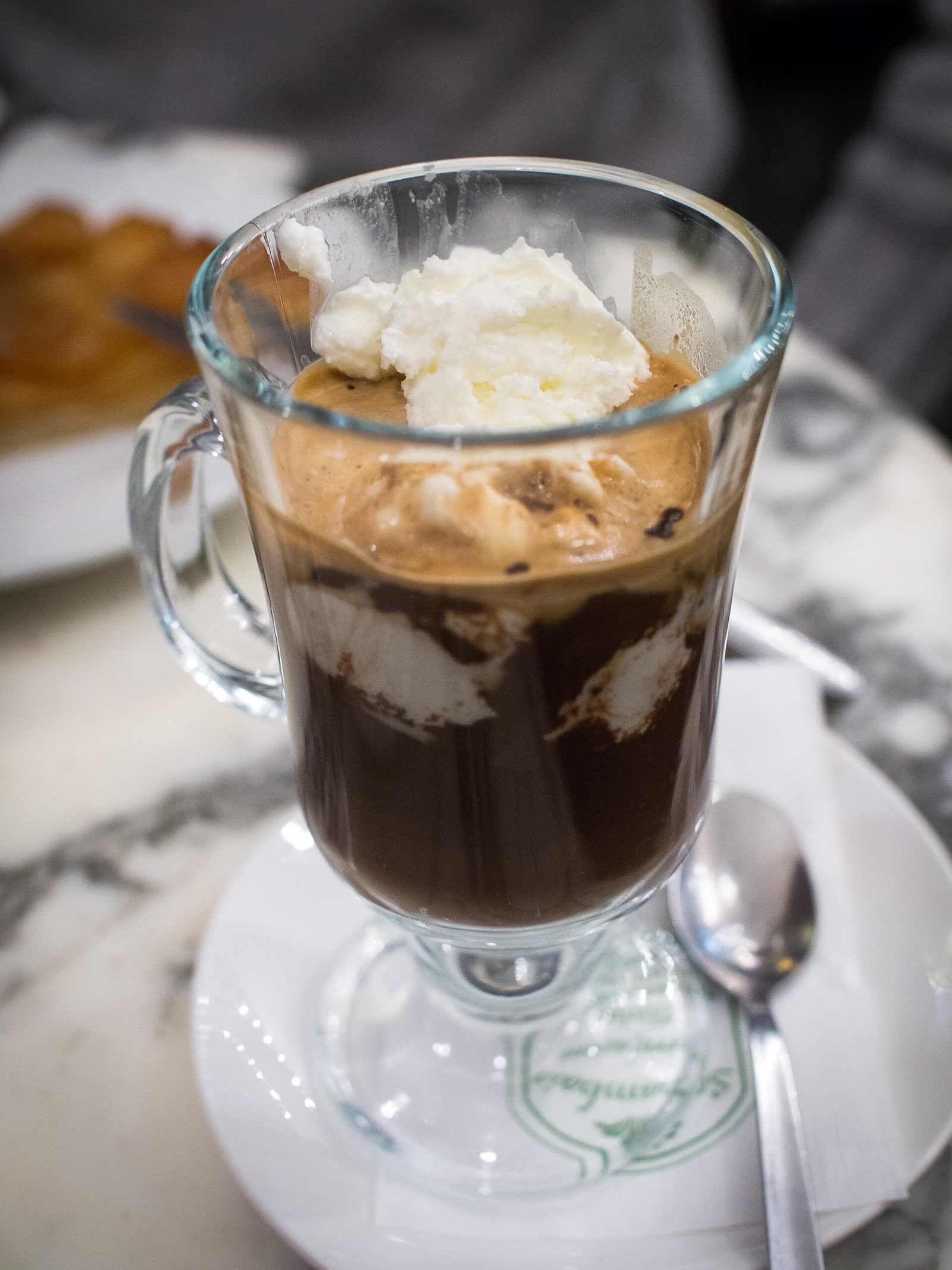
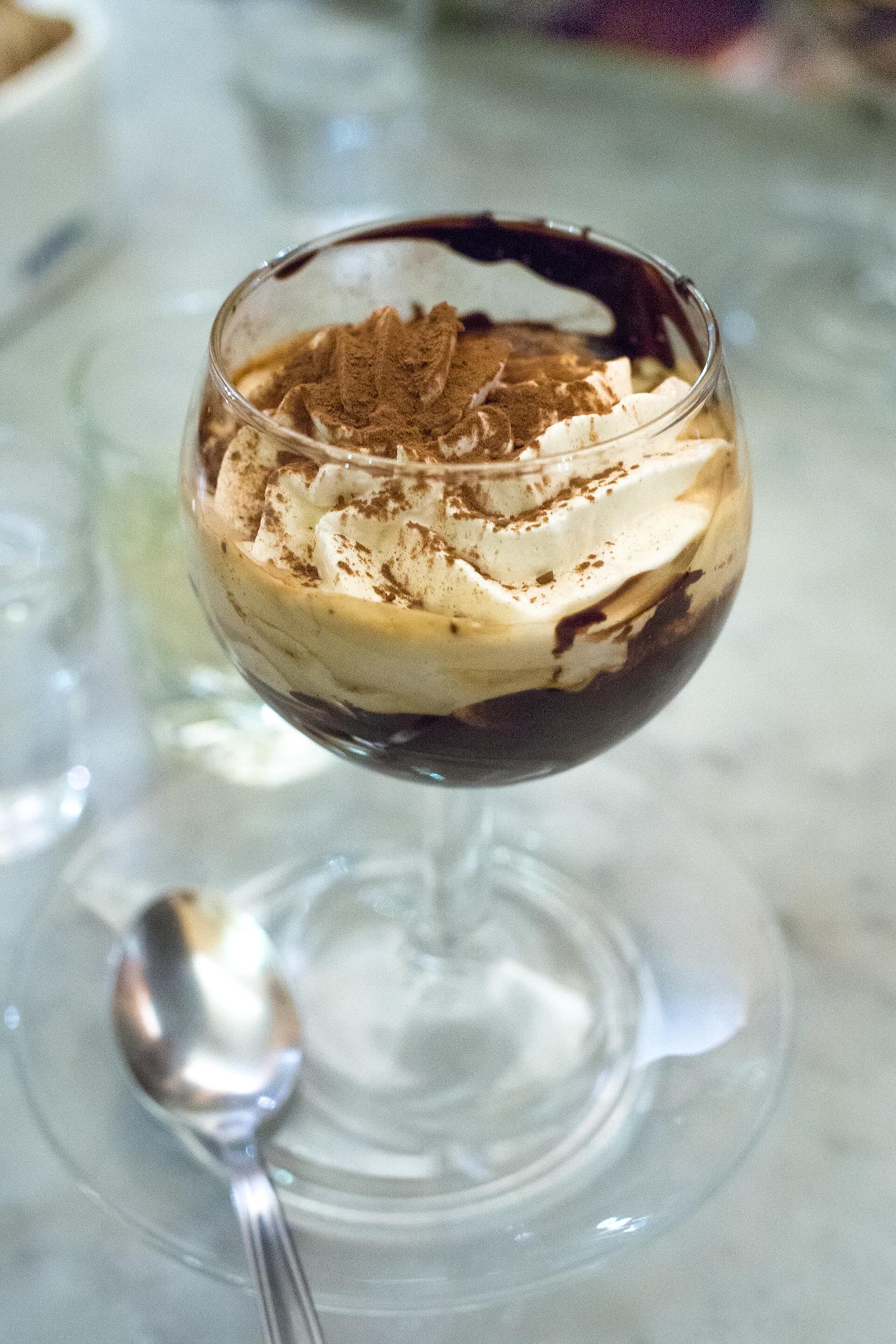
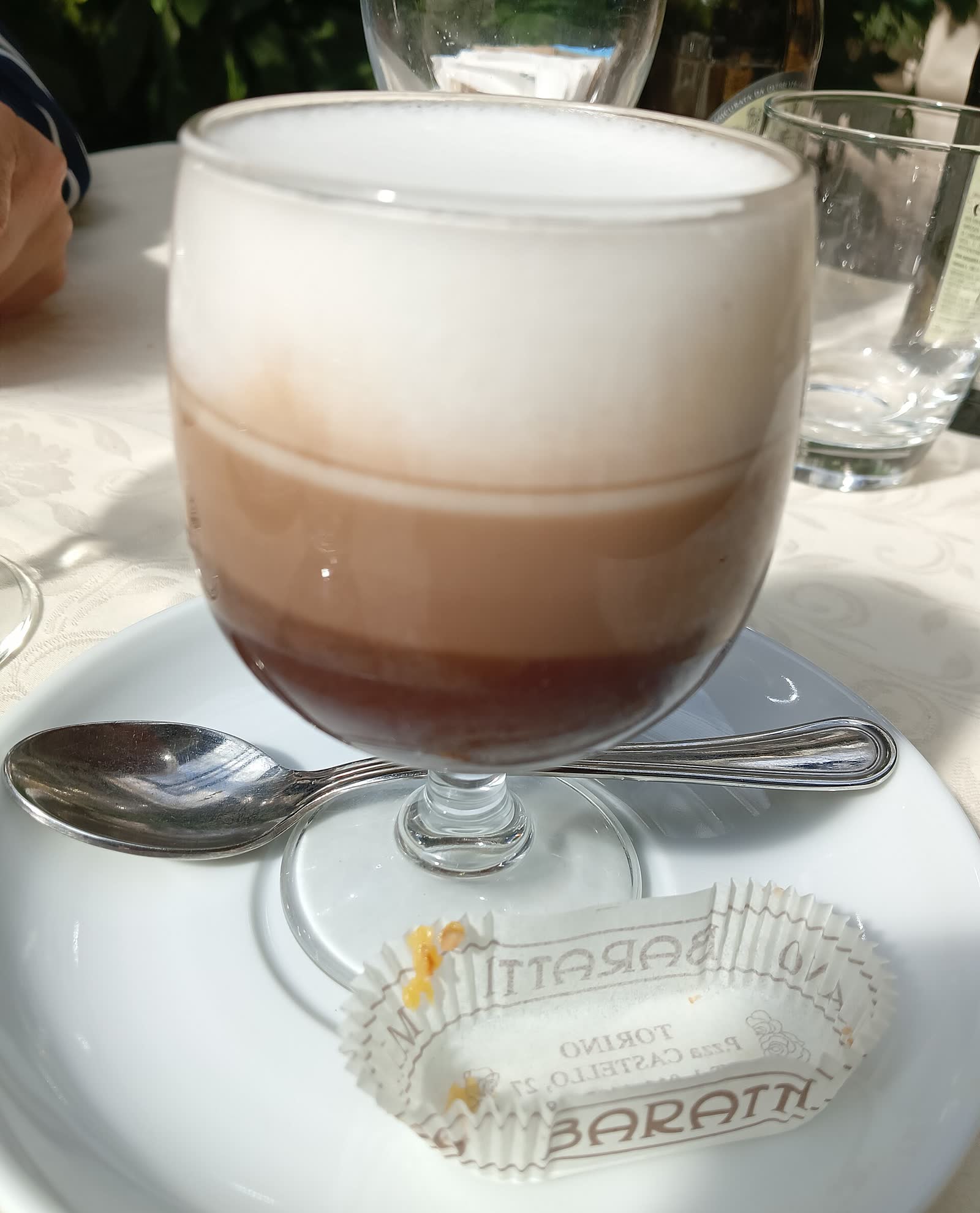
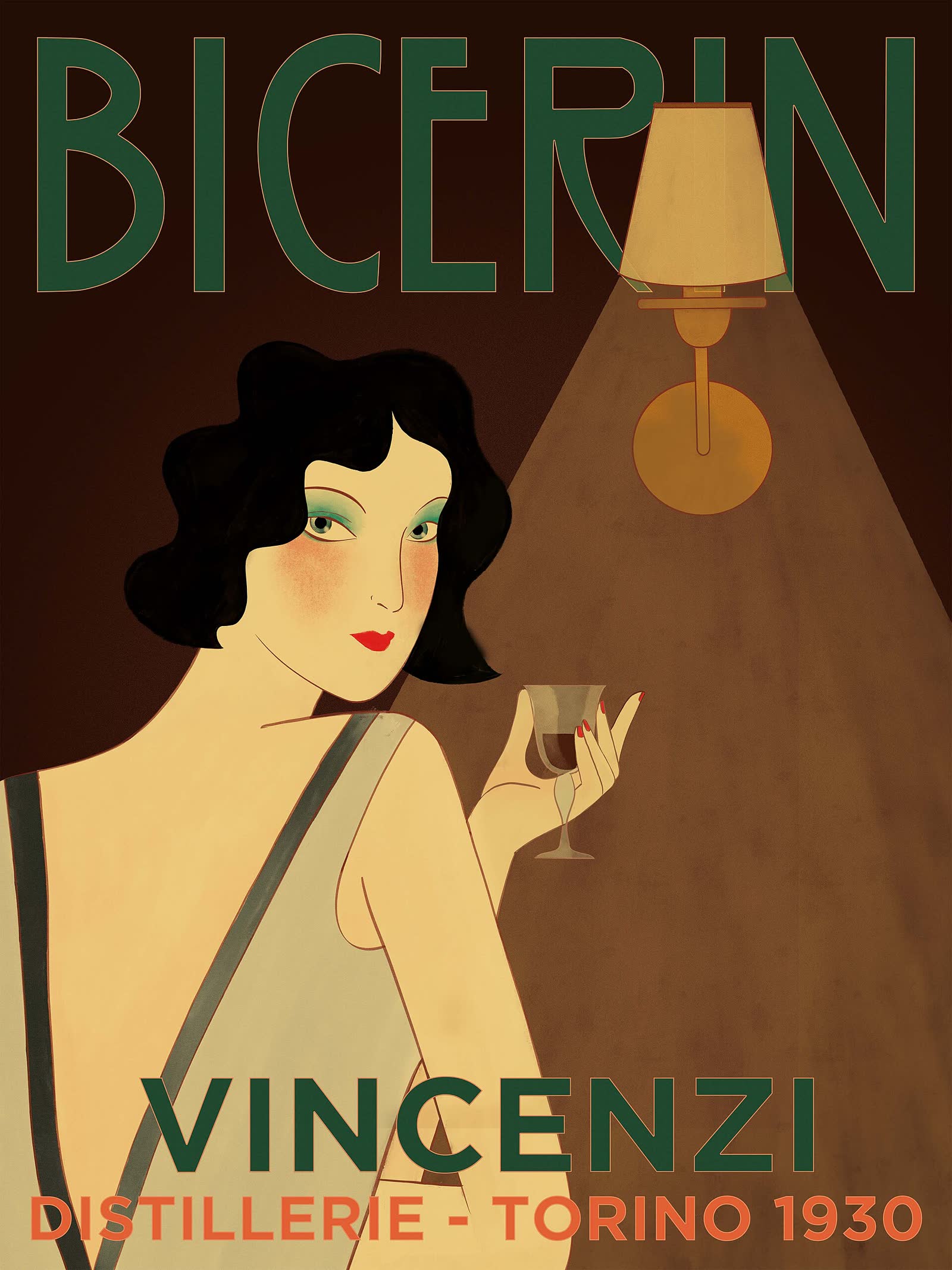
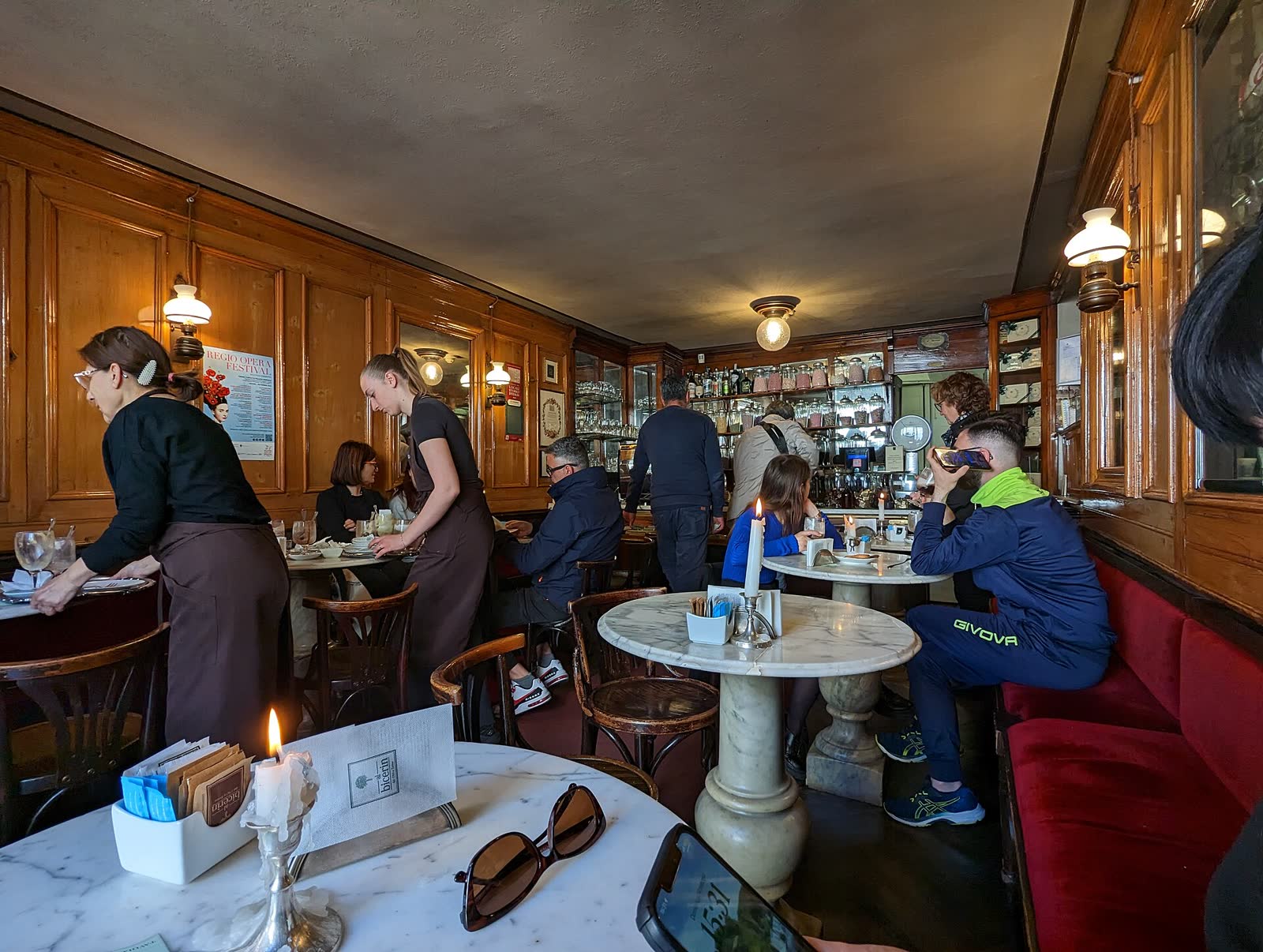
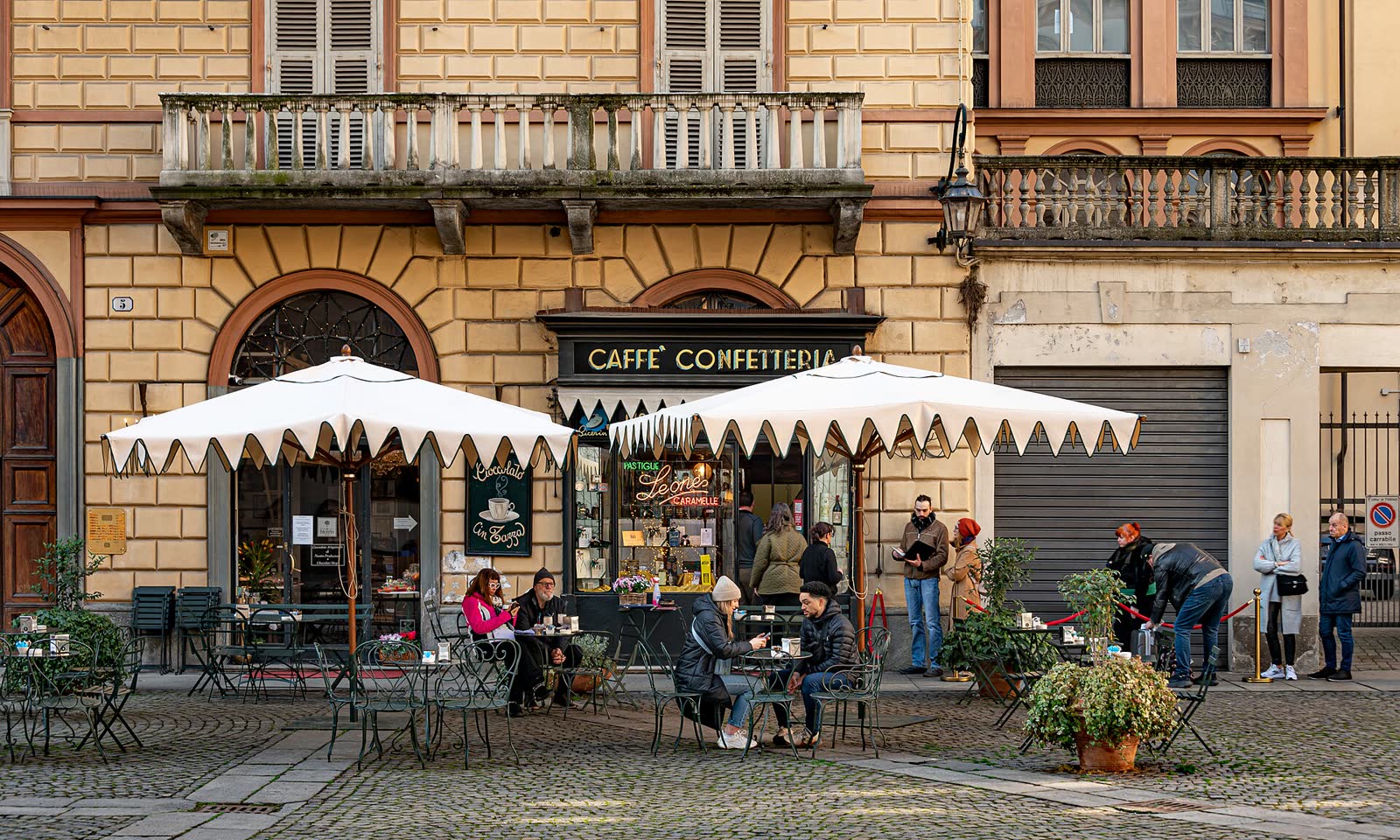
Two and a half centuries in the same glass
Before the bicerin there was the bavareisa, an 18th-century drink of coffee, chocolate and milk, served in big glasses and sweetened with syrup. In 1763 Giuseppe Dentis, a seller of cordials and sweets, opened a modest shop right across from the Consolata Sanctuary, and there the drink got smaller, settled into layers and took the name of the glass it was served in.
At first it came three ways: pur e fiur (coffee and cream, a bit like a cappuccino), pur e barba (coffee and chocolate) and 'n pòch ëd tut, "a little of everything", with all three. The last one won, and that's the one you drink today.
The café itself tells how it became a Lent habit, because hot chocolate wasn't considered food and could be drunk while fasting, for instance after Mass at the Consolata. The current building, by Carlo Promis, went up in 1856, and the café took the name of its speciality: Al Bicerin.
According to the café's history, Cavour, Silvio Pellico, Alexandre Dumas, Nietzsche, Puccini, Italo Calvino and Umberto Eco, who describes it in The Prague Cemetery, all sat at those tables. A detail I love: since 1917 it has almost always been run by women, from Ida Cavalli to Maria Teresa Costa, who made it famous between 1983 and 2015.
- 18th century: the bavareisa, the bicerin's grandmother
- 1763: Giuseppe Dentis opens facing the Consolata
- 1856: today's building and the name Al Bicerin
- 1898: Alberto Viriglio writes about it in Torino e i Torinesi
- 2001: a traditional food product of Piedmont
How to order it without stirring
Al Bicerin really is small: one room, eight round marble tables and a counter. There are no reservations, so here's how it goes.
Go early or on a weekday
It opens at 9am. On Saturday and Sunday mornings a queue forms on the pavement. First thing in the morning, or a weekday afternoon, you'll get in much more easily. And remember: it's closed on Wednesdays.
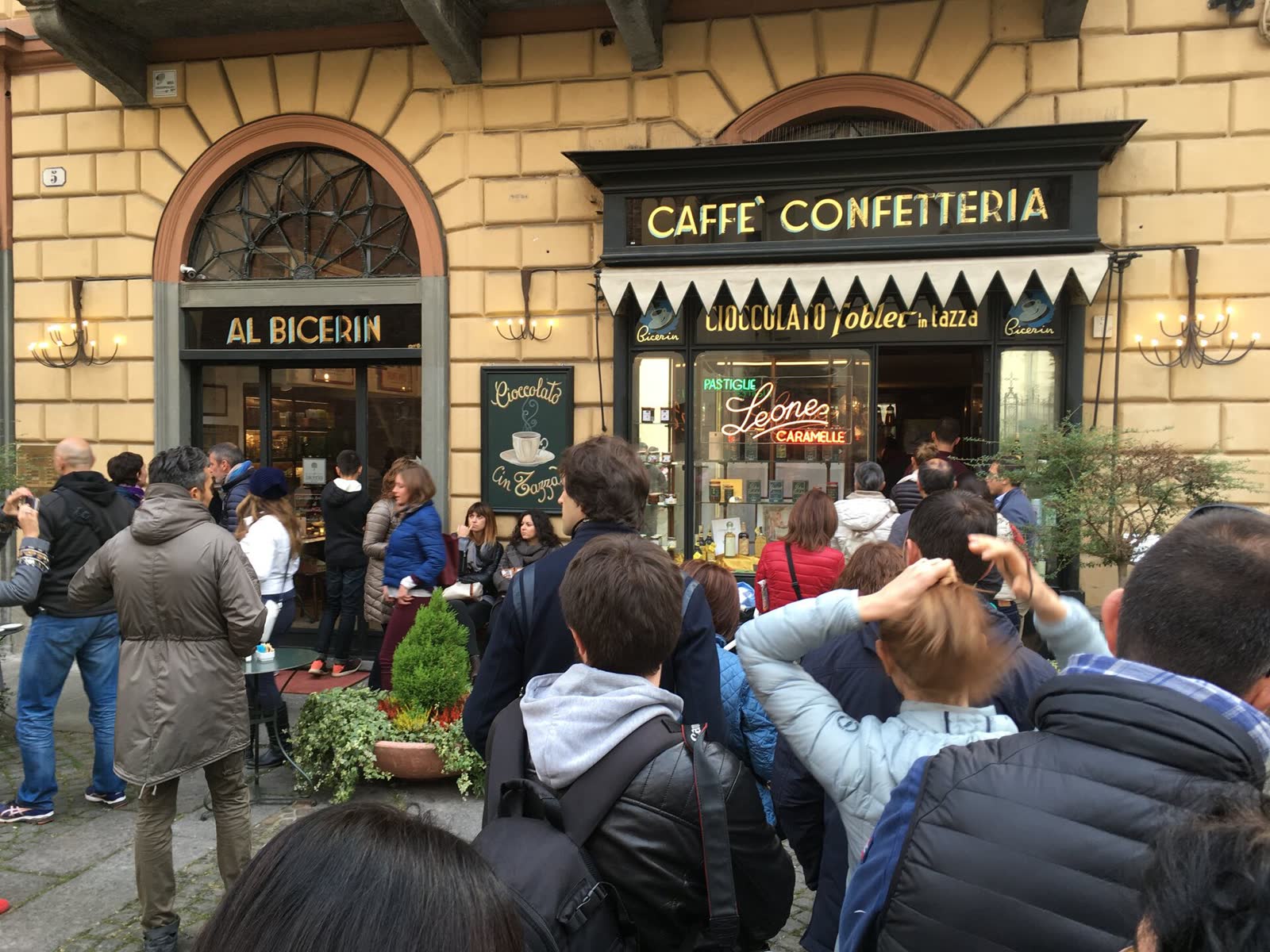
Sit down and ask for "un bicerin"
That's all. It's brought to your table in its little glass. If you want something with it, the menu has bagnati, Piedmontese biscuits for dunking: baci di dama, torcetti, hazelnut or meliga (cornmeal) biscuits.
The spoon isn't for stirring
Sip it from the rim, tilting the glass, so each mouthful brings cream, coffee and chocolate together. The chocolate left at the bottom, though, is fair game for the spoon at the end.
Look around
Wood panelling, mirrors, jars of colourful Leone pastilles behind the counter and a green-painted iron shopfront from the late 19th century. It's one of Italy's Historic Venues.
Opening hours 2026–2027 (Al Bicerin)
| When | Hours |
|---|---|
| Every day except Wednesday | 9:00 – 19:15 |
| Wednesday (weekly day off) | Closed |
| Wednesdays it opens anyway 23 and 30 Dec 2026 · 6 Jan, 23 Mar and 2 Jun 2027 | 9:00 – 19:15 |
| 24 and 31 December 2026 | until 16:00 |
| 25 December and 1 January | Closed |
Piazza della Consolata 5, 10122 Turin · +39 011 4369325. Hours as published by the café itself on bicerin.it; they change on specific dates, so check before you go.
2026 prices (in euros)
| What and where | Price |
|---|---|
| Bicerin at Al Bicerin, seated 2026 guides and reviews | 7 – 8.60 |
| Bicerin at a historic café, at a table Piazza Castello, Piazza San Carlo | 7 – 8.50 |
| Bicerin al banco (standing at the bar) Where it's served that way | 5 – 6.50 |
| A table on Piazza San Carlo You pay for the room and the square | from 9 |
| An espresso at the bar, for comparison Italian average, 2026 | ~1.25 |
None of these cafés publishes its price list online: these figures come from 2026 guides and reviews that quote them. Check the menu before ordering. What you pay extra at a table is the setting, not a better bicerin.
Other historic cafés to drink it in
There's only one original, but Turin is the city of Risorgimento cafés. These are all on the route, in the order you'll pass them.
The original or a café on the square
Both are worth it, and they're quite different. Here's the real difference.
Al Bicerin
- Where it was born, with the house recipe
- An intimate 19th-century chocolate shop
- Facing the Consolata, in the Quadrilatero Romano
- Weekend queues, no reservations
- Closed on Wednesdays
A historic café on the square
- Grand rooms, chandeliers and mirrors
- Usually a free table without waiting
- Open every day and until later
- Add gianduiotti, cremini or a tramezzino
- A table overlooking the square costs extra
One bicerin, and walk the rest
It's rich: dense chocolate, coffee and cream. Two in a row and you're out of the game for lunch. What I'd do is have it once, at the original, and do the rest of the route alternating espressos at the bar and looking at the rooms.
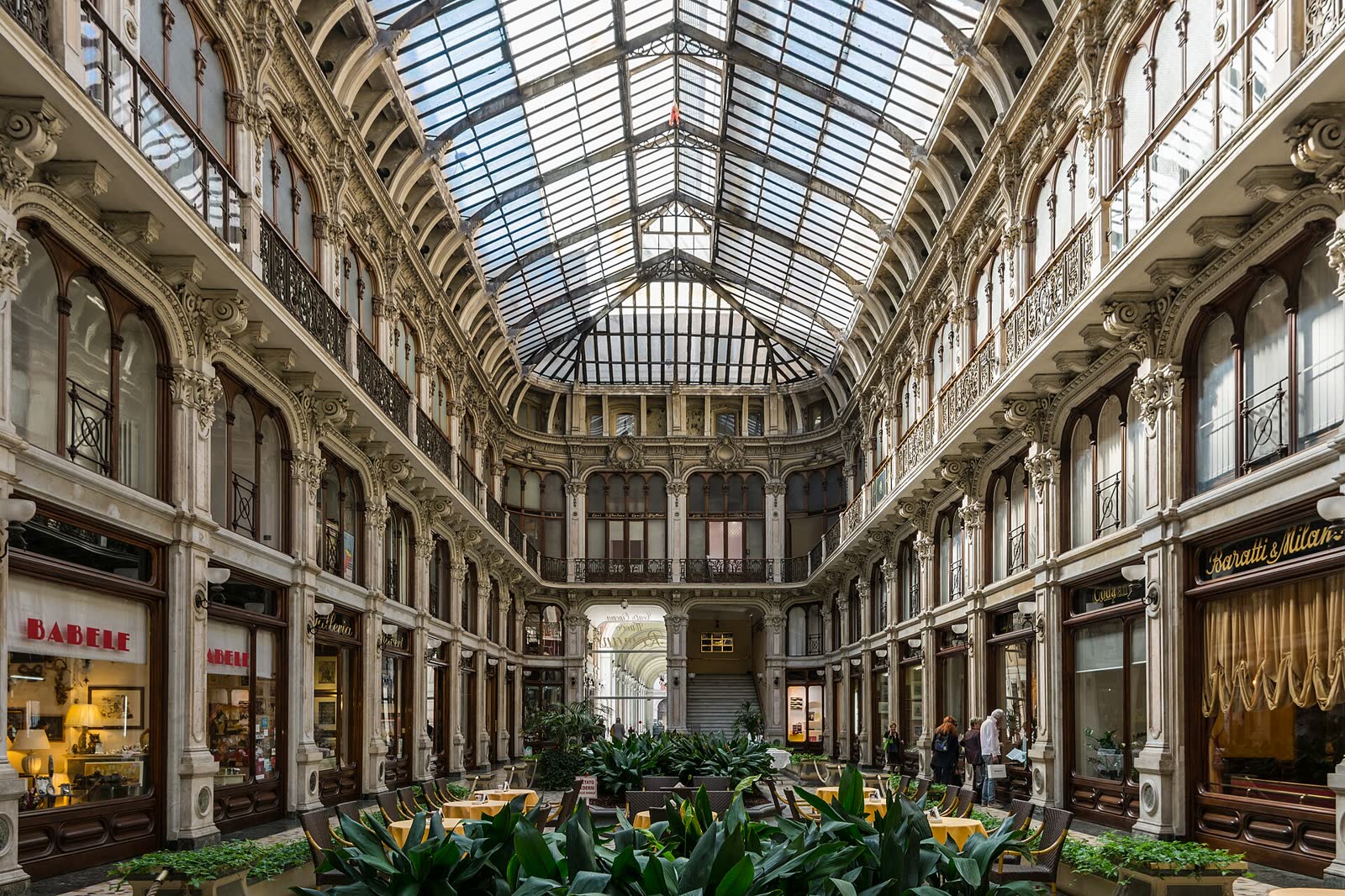
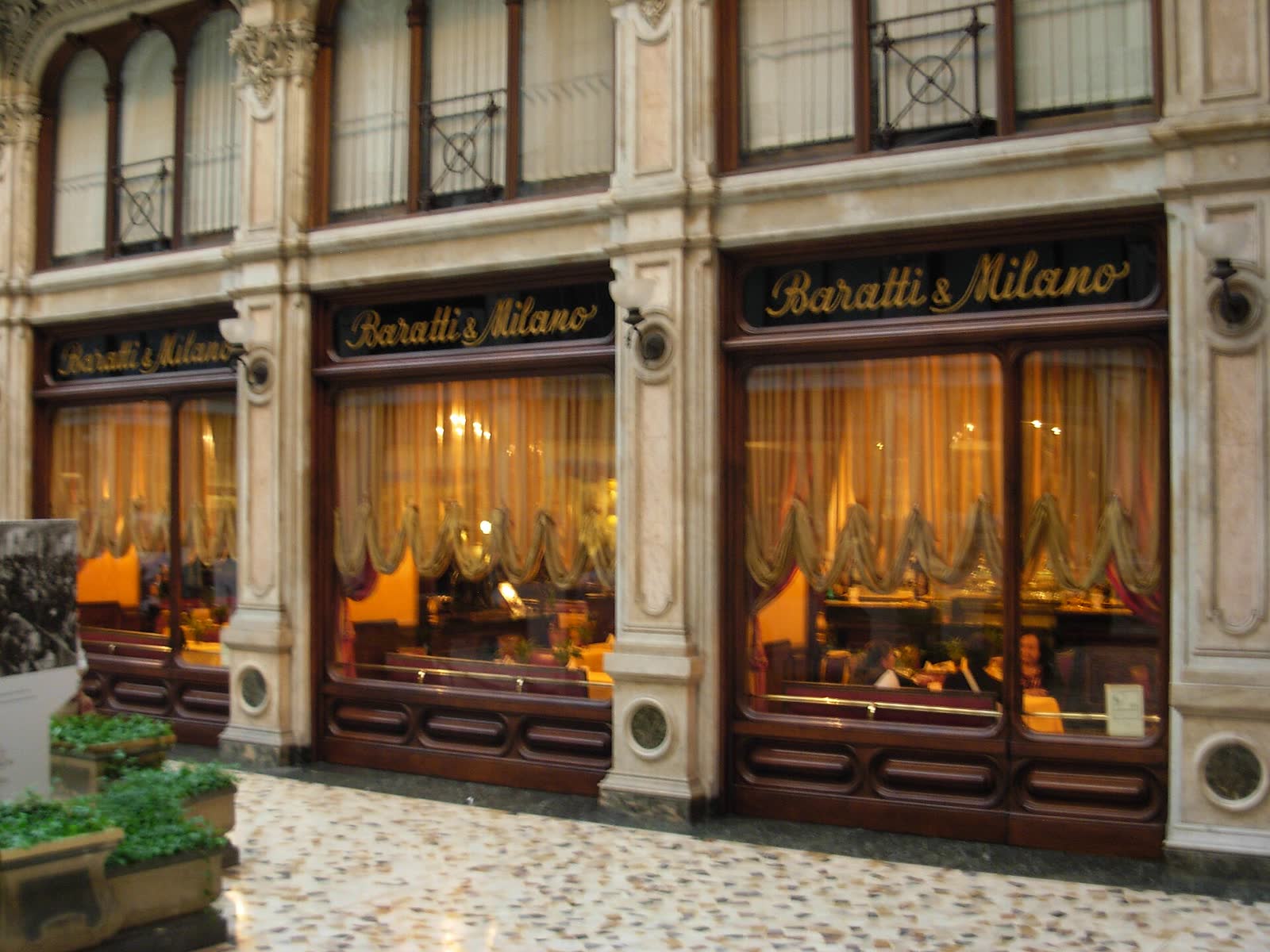
The morning I'd plan: 9am at Al Bicerin (any day but Wednesday), a look inside the Consolata, then down Via della Consolata and pedestrian Via Garibaldi to Piazza Castello. There, a standing espresso at Mulassano, the Galleria Subalpina with Baratti & Milano, and Fiorio at the start of Via Po. Then to Piazza San Carlo, with Caffè San Carlo, Caffè Torino and Stratta under the arcades, and finish at Platti, on Corso Vittorio Emanuele II, a few steps from Porta Nuova. About four kilometres, all flat and largely under arcades: it works even when it rains.
Seven things worth knowing
Winter break from 11 to 15 January 2027 (reopens Saturday the 16th). Over the holidays it's open from 17 December to 6 January except on the 25th and the 1st, and it closes at 16:00 on the 24th and 31st. The summer 2027 break is already announced: 28 July to 27 August, plus 23 to 25 June for San Giovanni, Turin's patron saint.
Official links
Photo and map credits
Photos via Wikimedia Commons: cover bicerin — Jeremy Hunsinger (CC BY 2.0); bicerin in a glass and in a goblet — Takeaway (CC BY-SA 4.0); bicerin with cream — Gartxoak (CC BY-SA 4.0); Caffè al Bicerin façade and Caffè Torino — Jorge Franganillo (CC BY 2.0); Al Bicerin interior — Ivan Ruggiero (CC BY-SA 4.0); queue at Al Bicerin — Lasagnolo9 (CC BY-SA 4.0); 1930 Bicerin liqueur poster — Andrea Vittorio Italo (CC0); Mulassano — Herbert wie (CC BY-SA 4.0); Baratti & Milano hall — Basilicofresco (CC BY-SA 4.0); Baratti & Milano windows — Enryonthecloud (public domain); Fiorio — Stijn Nieuwendijk (CC BY-SA 2.0); Caffè San Carlo — rene boulay (CC BY-SA 3.0); Piazza San Carlo — Benjamin Smith (CC BY-SA 4.0); Platti — Peter Glyn (CC BY-SA 4.0); Galleria Subalpina — Isiwal (CC BY-SA 4.0). Walking route: © OpenStreetMap contributors (ODbL) via BRouter. Base maps: © OpenStreetMap, © Esri, © OpenTopoMap (CC BY-SA), Esri World Imagery. Opening hours: bicerin.it (checked November 2026).